
Why Is My Overhead Press So Weak Compared to My Bench? (Full Real-World Guide)
If your overhead press feels embarrassingly weak compared to your bench, trust me, this happens to almost everyone. You can bench heavy, feel strong, and then the moment you try strict OHP… it humbles you instantly.
Most lifters have strength gaps, mobility issues, technique problems, or program mistakes without even knowing it. In this guide, I’ll explain everything clearly and show you what actually fixes a weak overhead press.
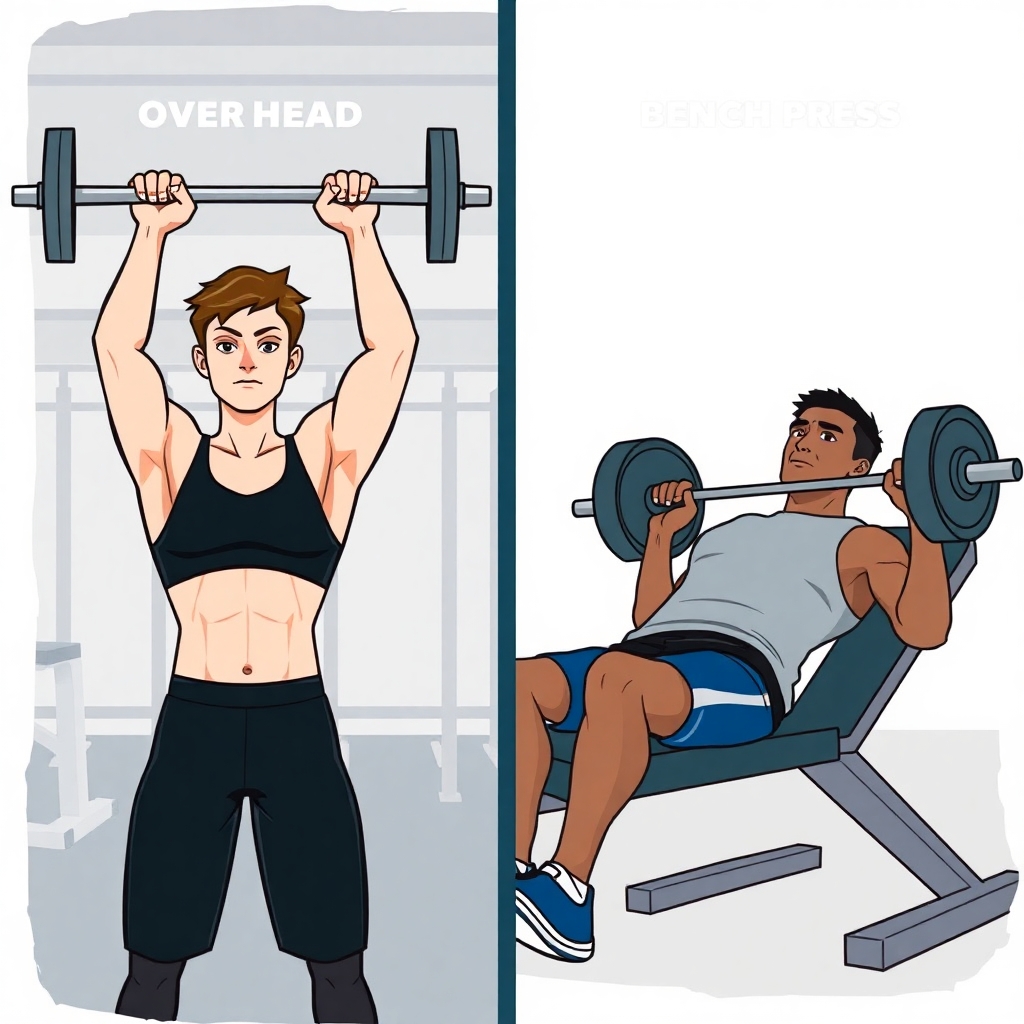
Bench Press vs Overhead Press: The Real Difference
Before fixing your OHP, you need to understand the mechanics. These two lifts are not even close.
Bench Press: Built for Strength
The bench press gives you more support and leverage.
Why bench is naturally stronger
| Factor | Bench Press Advantage |
|---|---|
| Body position | You lie on a bench, stable base |
| Muscle involvement | Chest + shoulders + triceps together |
| Leverage | Short bar path and stronger angles |
| Lower body | Leg drive adds power |
| Stability | The bench supports your spine |
This is why your bench always climbs faster.
Overhead Press: Harder by Design
The overhead press makes your body do everything.
Why OHP feels weaker
| Factor | Overhead Press Challenge |
|---|---|
| Position | Standing, no external support |
| Muscles | Mostly shoulders + triceps |
| Bar path | Longer distance to move the bar |
| Stability | Core + glutes must stay tight |
| Mobility | Requires shoulder & T-spine mobility |
The movement exposes weaknesses instantly.
Normal Bench-to-OHP Ratio
Most lifters fall around:
OHP = 55%–70% of bench press
If you bench 100 kg, pressing 55–70 kg is completely normal.
Here’s a quick ratio table:
| Bench Press | Normal OHP Range |
|---|---|
| 60 kg | 33–42 kg |
| 80 kg | 44–56 kg |
| 100 kg | 55–70 kg |
| 120 kg | 66–84 kg |
| 140 kg | 77–98 kg |
If your press is way below this, this guide will show you why.
1. Your Triceps Are the Weak Link
Most lifters fail the overhead press because their triceps can’t finish the lift. The chest helps in bench press, but in OHP your chest barely does anything.
Signs Triceps Are Your Issue
• You fail around forehead/eye level
• The lockout feels slow
• You can bench heavy but OHP barely moves
• Top part of press shakes or stalls
Triceps Fix Table
| Exercise | Why It Helps |
|---|---|
| Close-grip bench | Strongest tricep builder for OHP |
| Dips (weighted) | Builds pressing strength through full ROM |
| Overhead tricep extension | Directly strengthens lockout muscles |
| JM press | Teaches stability and lockout speed |
| Rope pushdowns | Volume work for triceps endurance |
A stronger triceps = a stronger overhead press almost every time.
2. Poor Scapular Stability (Weak Upper Back Control)
Your shoulder blades must rotate upward and stay stable to support the bar. If your upper back is weak, the bar drifts forward and the lift becomes harder.
Signs of Weak Upper Back
• Wobbly bar path
• You lean back during reps
• Shoulders feel unstable
• Hard to hold weight overhead
Upper Back Fix Table
| Exercise | Benefit |
|---|---|
| Face pulls | Improves scap movement & shoulder health |
| Wall slides | Strengthens upward rotation |
| Scapular pull-ups | Builds control in overhead range |
| Overhead dumbbell holds | Teaches stability under load |
| Band Y-raises | Strengthens lower traps |
Better scap control = smoother OHP.
3. Shoulder or T-Spine Mobility Problems
Weakness isn’t always the issue. Sometimes you simply don’t have the mobility to press properly.
Mobility Problems That Limit Strength
• Tight lats pull bar forward
• Rounded upper back reduces power
• Shoulders can’t fully flex overhead
• Must lean back and press like an incline
How to Know Mobility Is Your Problem
• Bar drifts forward
• Lower back arches too much
• Shoulders hurt at the bottom
• Pressing feels blocked the higher you go
Mobility Fix Table
| Drill | What It Fixes |
|---|---|
| PVC pass-throughs | Opens shoulders |
| Wall-facing press | Forces correct bar path |
| Lat stretch | Frees bar path from drifting forward |
| T-spine foam rolling | Makes the overhead position comfortable |
| Shoulder flexion stretch | Helps reach lockout without leaning back |
Mobility work makes the bar path cleaner and stronger.
4. Weak Core or Poor Bracing
Your body is the bench when you overhead press. If your core can’t stabilize, the bar path becomes messy.
Signs Your Core Isn’t Bracing Well
• You lean back excessively
• You feel lower back pressure
• Ribs flare forward
• Bar path loops instead of going straight
Core Fix Table
| Exercise | Benefit |
|---|---|
| Ab wheel | Best core strength for pressing |
| Planks | Builds stability and bracing endurance |
| Farmer carries | Teaches full-body tension |
| Deadbugs | Fixes rib flare and core control |
| Pause OHP | Forces strong bracing |
A solid core lets you press heavier with safer form.
5. Technique Issues (Most Lifters Mess This Up)
Even strong lifters fail OHP because their technique isn’t clean.
Common Mistakes
• Pressing the bar forward
• Elbows too far behind the bar
• Loose glutes and loose core
• Not moving the head out/in correctly
• Wrists collapsing backward
Technique Fixes
• Squeeze glutes hard
• Keep elbows slightly in front of bar
• Move head back, then through
• Keep bar close to your face
• Stack wrist → elbow → shoulder vertically
Good form adds kilos without adding muscle.
6. Your Training Program Isn’t Helping Your OHP
Overhead press grows slowly unless you increase frequency. Training it once a week almost never works.
A Simple Weekly OHP Program
| Day | Focus | Goal |
|---|---|---|
| Day 1 | Heavy OHP | Low reps, build strength |
| Day 2 | Volume dumbbell or OHP | Hypertrophy for shoulders |
| Day 3 | Push press or triceps focus | Overload top range |
This setup works for beginners and intermediates.
Best Accessories
• Lateral raises
• Seated DB shoulder press
• Incline bench
• Face pulls
• Push press
• Pause OHP
Growing your shoulders = growing your overhead press.
7. Your Body Structure Might Not Favor OHP
This doesn’t mean you can’t get strong — it just means some people have natural advantages.
Arm Length & Leverage Table
| Build Type | OHP Impact |
|---|---|
| Long arms | Harder bar path, weaker lockout |
| Short arms | Easier press, stronger overhead numbers |
| Thick upper body | Better stability |
| Narrow frame | Harder to stabilize overhead |
Even if you have long arms, smart programming can close the gap.
Overhead Press Strength Standards (Realistic Numbers)
Here’s where most lifters fall:
| Level | Typical OHP % of Bench | Notes |
|---|---|---|
| Beginner | 40–50% | Pressing the empty bar is okay |
| Intermediate | 55–65% | Average gym lifter range |
| Advanced | 70–80% | Strong overhead presser |
| Elite | 85%+ | Rare without serious training |
If you’re anywhere between 55–70%, you’re doing well.
FAQs (Straightforward Answers)
Why is my overhead press weaker than my bench even though I train both?
Because the bench uses your chest, shoulders, and triceps together, while the OHP relies more on shoulders and triceps only. Less muscle = less weight.
Does shoulder mobility affect overhead press strength?
Yes, tight lats or stiff shoulders can pull the bar forward and kill your power. Better mobility usually adds instant strength.
Should I lean back when I press overhead?
A small lean is normal, but too much means your core isn’t bracing or your mobility is bad. If it feels like an incline press, it’s wrong.
Why does the bar drift forward when I press?
Weak upper back muscles or poor bar path control. Strengthen your scapular muscles and keep the bar close to your face.
Is overhead press bad for shoulders?
Not if you do it correctly. Good form actually improves shoulder health by strengthening the stabilizers.
How much stronger can I expect my OHP to get?
If you’re a beginner, you can add weight fast. Intermediates usually see slow progress. Even adding 2.5 kg every month is solid.
Should I do seated or standing overhead press?
Standing builds more total-body strength and stability. Seated lets you focus more on your shoulders. Both help.
What’s the best rep range for improving OHP?
Heavy strength sets: 3–5 reps
Volume hypertrophy sets: 6–12 reps
Both matter.
Do lateral raises help my overhead press?
Yes. Strong side delts give your shoulder joint more stability and make the press feel smoother.
Can I improve my OHP without gaining bodyweight?
Yes, but it’s slower. Stronger triceps, better technique, and better mobility will help even without bulking.
Why do I feel shoulder pain only at the bottom of the press?
Likely a mobility problem or weak rotator cuff muscles. Try warming up with lighter movements and pause reps.
Does grip width affect overhead press strength?
Absolutely. A slightly narrower grip often gives more power and reduces shoulder stress.
Why do I arch my back during OHP?
Your core and glutes aren’t tight enough, or your shoulder mobility is limited. Bracing fixes most of it.
How long does it take to fix a weak overhead press?
If you follow a good program, most lifters see solid improvement within 6–8 weeks.
Should beginners focus on OHP or bench first?
Bench is easier to learn, but OHP builds full-body strength. Training both is best.
Is it normal to fail early when doing OHP volume sets?
Yes. The shoulder muscles fatigue quickly. That’s why progression is slow.
Conclusion
Your overhead press isn’t weak because you aren’t strong. It feels weak because the lift is demanding and exposes every weakness in your upper body, mobility, and technique.
Fix your triceps, stabilize your upper back, clean up your bar path, improve your mobility, and press more often. Once you do this, your overhead press will climb faster than you expect — even if it’s been stuck for months.