ONE-REP MAX CALCULATOR
Your Estimated 1RM
Bench Press
1 Rep max calculator
Welcome to OneRepMaxCalculator.online, a platform created by and for gym lovers who believe in training smarter, not just harder. Whether you’re working on strength, building muscle, or refining your performance, understanding your one rep max (1RM) is one of the most effective ways to make progress in the gym. This calculator is designed to help you estimate your max for a wide range of exercises: from compound lifts like squats, deadlifts, and overhead press to bodyweight variations like dips and pull-ups.

Our calculator includes selectable exercise types—Deadlift, Squat, Overhead Press, Bench Press, Barbell Row, Pull-Up, Dip—and supports multiple 1RM formulas including Epley, Brzycki, Lombardi, O’Conner, and more. You choose the lift, input your weight and reps, pick your formula, and get a tailored 1RM result based on your training preference. This is not just a generic strength calculator. It’s built to suit lifters who care about precision.
What Is a One Rep Max and Why Does It Matter?
Your one rep max (1RM) is the maximum weight you can lift for a single repetition with correct form. It’s used by coaches and athletes alike to set percentage-based training targets and to monitor long-term strength development. Knowing your 1RM helps take the guesswork out of training, especially when planning progressive overload, hypertrophy blocks, or recovery sessions.

A well-estimated 1RM allows beginners to lift safely, intermediate lifters to avoid plateaus, and advanced lifters to time their peak strength phases effectively. It also provides reference for training programs like 5×5, Wendler 5/3/1, or hypertrophy splits that require specific percentages of your 1RM.
Exercises You Can Calculate With Our Tool
You can calculate your one rep max for the following exercises directly on the homepage:
Deadlift 1RM Calculator – Ideal for tracking lower body posterior chain strength
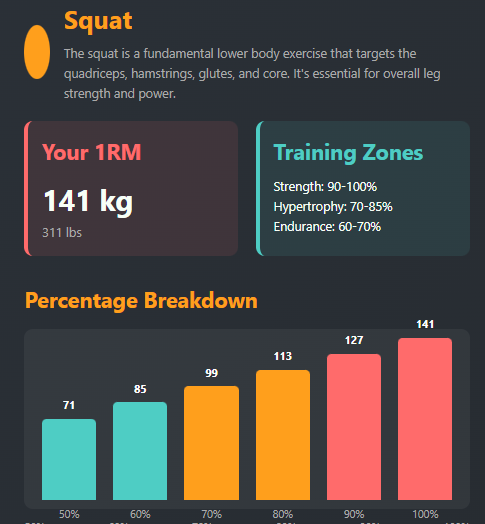
Squat 1RM Calculator – Estimate your back or front squat max using multiple rep ranges
Overhead Press 1RM Calculator – Test shoulder strength and progress
Bench Press 1RM Calculator – Measure pressing power from your chest and triceps
Barbell Row 1RM Calculator – Gauge pulling strength for the upper back
Pull-Up 1RM Calculator – Especially useful for weighted pull-up progressions
Dip 1RM Calculator – Estimate pushing strength using added weight
Whether you’re doing barbell, dumbbell, or bodyweight movements with resistance, the tool adapts to your routine.
Choose From the Most Reliable 1RM Formulas
Our tool lets you choose between the most widely accepted one rep max formulas, so you can compare estimates or stick with the one that matches your training philosophy:
| Formula | Best Use Case |
|---|---|
| Epley | Broad rep ranges (1–10 reps) |
| Brzycki | Low to moderate reps (up to 10 reps) |
| Lombardi | Ideal for heavy lifters with low reps |
| O’Conner | Accurate for moderate weight sessions |
| Wathan | Used in athletic strength programs |
| Mayhew | Based on collegiate lifting data |

Each formula has slight variations. Our tool runs them simultaneously when needed, so you can compare results.

Sample Input Table for Squat Calculation
| Weight Lifted | Reps | Formula | Estimated 1RM |
|---|---|---|---|
| 140kg | 5 | Epley | 162.7kg |
| 140kg | 5 | Brzycki | 161.8kg |
| 140kg | 5 | Lombardi | 158.9kg |
Use this breakdown to understand which formula aligns best with your performance history.
Why This Tool Works for Bodyweight Movements Like Pull-Ups and Dips
When training calisthenics or bodyweight strength, estimating one rep max isn’t always straightforward. Our calculator solves that. Just select pull-up or dip, then enter the added resistance (e.g., with a dip belt or vest). Combine the result with your bodyweight to get the total estimated 1RM.
For example:
| Added Weight | Bodyweight | Reps | Total Load | Est. 1RM (Epley) |
|---|---|---|---|---|
| 15kg | 70kg | 5 | 85kg | 101.2kg |
This approach gives accurate insight for weighted calisthenics progress.
Why We Included So Many Formulas
Different rep ranges respond better to different equations. A heavy triple may be best interpreted by Lombardi, while an 8-rep set aligns better with Brzycki or O’Conner. By offering the ability to choose and compare, we help you understand your training response better and make more informed adjustments.
Planning Hypertrophy and Strength With 1RM Estimates
A big reason to know your one rep max is to plan your training loads with more control. Here’s how the estimates align with training goals:
| Goal | % of 1RM | Rep Range |
|---|---|---|
| Power | 90–100% | 1–3 reps |
| Strength | 80–90% | 3–6 reps |
| Hypertrophy | 70–85% | 6–12 reps |
| Endurance | 60–70% | 12–20 reps |
Training within these percentages keeps your sessions focused on the right outcomes.
Support for 5×5, 5/3/1, and Progressive Programs
If you’re using popular training systems like StrongLifts 5×5 or Wendler 5/3/1, you’ll often see prescribed percentages based on your 1RM. Our calculator helps translate your max into the working weights needed to follow these routines precisely.
| Program | Week | % of 1RM | Example 1RM: 100kg |
|---|---|---|---|
| 5×5 | All | 85% | 85kg |
| 5/3/1 | W1 | 75–85% | 75–85kg |
| 5/3/1 | W2 | 80–90% | 80–90kg |
This kind of programming leads to consistent gains without burnout.
Real Reviews From Lifters Who Use This Calculator
🏋️♂️ ★★★★★ 5/5 – Exactly What I Needed
“I really like that I can select different lifts. It makes it easier to log progress across all my major movements. It’s fast, accurate, and way better than the other ones I’ve tried.”
— Jordan T., Powerlifter
💪 ★★★★☆ 4.5/5 – Great for Trainers
“I’m a personal trainer and use this every week with clients. Being able to switch between formulas helps me tailor sessions based on their experience levels. It saves time and builds trust.”
— Lisa F., Strength Coach
🔥 ★★★★★ 5/5 – Finally! Pull-Ups and Dips Included
“Most tools ignore calisthenics, but this one delivers. I use it to track weighted dips and pull-ups regularly and it’s been a game-changer for my progression.”
— Samir K., Bodyweight Athlete
✅ ★★★★☆ 4.7/5 – Clean and Reliable
“No fluff, just solid calculations. The interface is super clean, and I appreciate how it lets you compare multiple formulas. Definitely bookmarked.”
— Diana R., Intermediate Lifter
📈 ★★★★★ 5/5 – Perfect for Strength Programs
“I follow a 5/3/1 plan and this tool helps me nail my percentages every week. It’s like having a coach in your pocket without the cost.”
— Ankit V., Garage Gym Owner
Frequently Asked Questions
Can I trust the one rep max result if I only did 5 reps?
Yes. One rep max (1RM) calculators are designed to estimate your maximum strength from submaximal reps like 3–10 reps. Formulas like Epley, Brzycki, Lombardi, Mayhew, O’Conner, and Wathan adjust for different rep ranges. Make sure you performed the reps with proper technique and controlled tempo. If you are calculating your bench press, squat, deadlift, or overhead press 1RM, these formulas will give reliable estimates. For dips or weighted pull-ups, include your bodyweight plus extra load for accurate results.
Which formula should I use for heavy singles or triples?
For low-rep, high-weight lifts like singles or triples, the Lombardi or Epley formulas are generally more accurate. Brzycki and Mayhew work better for higher rep ranges. Comparing results across multiple formulas can help you understand your strength trends for bench press, squat, overhead press, or barbell row.
How is a pull-up or dip max calculated?
For bodyweight exercises like pull-ups, chin-ups, or dips, input only the additional weight you’re using (like a weighted belt). Then manually add your bodyweight to calculate the total load lifted. This method also works for weighted push-ups, ring dips, and gymnastic strength exercises.
Do I need to select different formulas for different lifts?
Not necessarily. Most 1RM formulas can be applied to bench press, squat, deadlift, overhead press, dips, and rows. However, experimenting with Brzycki vs. Epley vs. Lombardi can reveal how your strength responds across different rep ranges, which is useful for tracking progress week-to-week or month-to-month.
Does it work for both kg and lbs?
Yes. You can toggle between kilograms (kg) and pounds (lbs) anytime. Whether you are training in a gym or at home, all bench press, squat, overhead press, and bodyweight lift calculators support both units.
Can I calculate 1RM for any exercise, not just bench press or squat?
Yes. Our 1RM calculator works for almost any lift where you can track reps and weight, including deadlifts, barbell rows, overhead presses, dips, pull-ups, and even dumbbell variations. Make sure to enter the weight lifted and reps completed for accurate results.
How accurate is the 1RM calculator for different rep ranges?
Accuracy varies by formula and rep range. Low reps (1–5) give more precise estimates for heavy lifts, while high reps (6–12) may slightly overestimate your max strength. Using multiple formulas like Epley, Brzycki, or Lombardi helps cross-check results for bench press, squat, or overhead press.
Can I track progress with this 1RM calculator?
Yes. You can track your bench press, squat, deadlift, overhead press, or bodyweight exercise progress over time. Many athletes use it to monitor strength gains, compare rep-to-1RM ratios, or plan progressive overload training programs.
Can I use this 1RM calculator for beginners?
Absolutely. Beginners can estimate 1RM safely without lifting maximum weight. Using submaximal reps allows new lifters to calculate 1RM for bench press, squat, overhead press, dips, or rows safely. Always focus on form and controlled reps to avoid injury.
How do I calculate 1RM for accessory lifts or isolation exercises?
For isolation lifts like bicep curls, tricep extensions, or lateral raises, you can use the 1RM calculator as long as you know the weight lifted and reps completed. Estimates for isolation exercises are less critical than for compound lifts but are still useful for tracking progress.
What is the difference between estimated 1RM and actual 1RM?
Estimated 1RM is calculated from formulas based on your reps and weight, while actual 1RM is the maximum weight you can lift for one rep. Estimated 1RM is safer and practical for bench press, squat, overhead press, and dips, reducing injury risk while giving a reliable benchmark.
Are there calculators for each specific lift?
Yes. On our site, you can find specialized calculators for bench press, squat, overhead press, dips, deadlift, and weighted pull-ups. Using these targeted calculators helps fine-tune your training program for specific lifts and track improvements accurately.
Can I calculate my 1RM if I train with dumbbells instead of a barbell?
Yes. The 1RM calculator works for both barbell and dumbbell exercises, including dumbbell bench press, dumbbell shoulder press, and dumbbell rows. Just enter the weight of one dumbbell and reps performed. For lifts with two dumbbells, use the total combined weight.
How can I use my 1RM to plan workout percentages?
Once you know your 1RM for exercises like bench press, squat, or overhead press, you can calculate training weights for different rep ranges. For example, 70% of 1RM → 10 reps, 80% → 6 reps, 90% → 3 reps. This helps with progressive overload and designing strength, hypertrophy, or endurance programs.
Can the 1RM calculator help prevent injury?
Yes. Using estimated 1RM allows you to train safely without lifting your actual max. This is especially useful for bench press, squat, overhead press, dips, and pull-ups, where lifting maximum weight can increase injury risk. Always pair your 1RM calculations with proper warm-up and form.
Can I calculate 1RM for bodyweight exercises without added weight?
Yes. For pull-ups, dips, and push-ups, the calculator can estimate your 1RM based on reps using only bodyweight. For more advanced training, you can add weighted vests or belts to see your max potential.
How does fatigue affect 1RM calculations?
Fatigue can slightly reduce your estimated 1RM. For accurate results, perform the exercise fresh, with proper form and controlled reps. This is especially important for squat, deadlift, bench press, and overhead press. Avoid using a fatigued set to calculate 1RM.
Can I calculate 1RM for complex lifts like clean and jerk or snatch?
Yes, but results may be less precise for Olympic lifts due to technique variability. For clean and jerk, snatch, or power clean, the calculator can give an estimate based on submaximal reps, but always prioritize technique and safety.
How often should I recalculate my 1RM?
Recalculate every 4–6 weeks or whenever you increase training loads significantly. Tracking 1RM for bench press, squat, deadlift, overhead press, and dips helps monitor strength gains and plateaus.
Can I use the 1RM calculator for women’s strength training?
Yes. The calculator is suitable for all genders. Enter the weight lifted and reps completed, whether for bench press, squat, overhead press, deadlift, or bodyweight exercises. Formulas like Epley, Brzycki, and Lombardi work for everyone.
Can I calculate 1RM for supersets or circuits?
It’s best to calculate 1RM on fresh sets because supersets or circuits induce fatigue, which can lower estimates. Use the calculator for standard sets of bench press, squat, dips, or overhead press for accurate results.
What if I don’t know my exact weight lifted or reps?
Accuracy depends on correct input. If unsure, estimate conservatively or repeat the set with measurable weight and reps. You can still track trends in bench press, squat, overhead press, or dips even if the exact 1RM is slightly off.
Can this calculator help with powerlifting or strength competitions?
Yes. Powerlifters often use 1RM calculators to plan attempts for squat, bench press, and deadlift. It helps with training cycles, attempt selection, and percentage-based programs, improving competition readiness.
Does 1RM calculation differ between free weights and machines?
Slightly. Machines may feel easier due to stabilization assistance, but formulas still provide reasonable estimates. Always input the weight actually lifted and reps performed, whether using bench press machine, leg press, or Smith machine.
Can I calculate 1RM for endurance-focused exercises?
Yes, though the estimate is more relevant for strength-oriented sets. For high-rep endurance exercises, formulas like Epley or Brzycki may overestimate max strength, but they can still guide program design for hypertrophy or endurance.
How can I use multiple calculators together?
Our site offers 1RM calculators for bench press, overhead press, dips, squats, and more. You can use them together to track overall strength progress, compare lifts, or adjust training programs based on your strongest or weakest lifts.
Is there a difference between training 1RM and testing 1RM?
Yes. Training 1RM is estimated from submaximal lifts, whereas testing 1RM is the actual maximum weight lifted for one rep. Training 1RM is safer and helps progressively increase strength in bench press, squat, deadlift, or dips without risking injury.
How does rep range affect 1RM estimates for different lifts?
Different rep ranges produce slightly different 1RM results: 1–5 reps → most accurate for heavy compound lifts, 6–12 reps → may slightly overestimate max strength, 12+ reps → useful for endurance, less reliable for actual 1RM. This applies to bench press, squat, overhead press, dips, and pull-ups.
Final Word: Why Use OneRepMaxCalculator.online
We built this calculator to go beyond the basics. With support for multiple lifts, selectable 1RM formulas, and data outputs tailored to strength and hypertrophy, OneRepMaxCalculator.online is more than a basic conversion tool—it’s a serious training companion. Whether you’re just getting started or have years under the bar, knowing your numbers can help you train harder and recover smarter.
Use the calculator now to find your true strength across deadlifts, squats, overhead press, and more. Lift with precision, not guesswork.